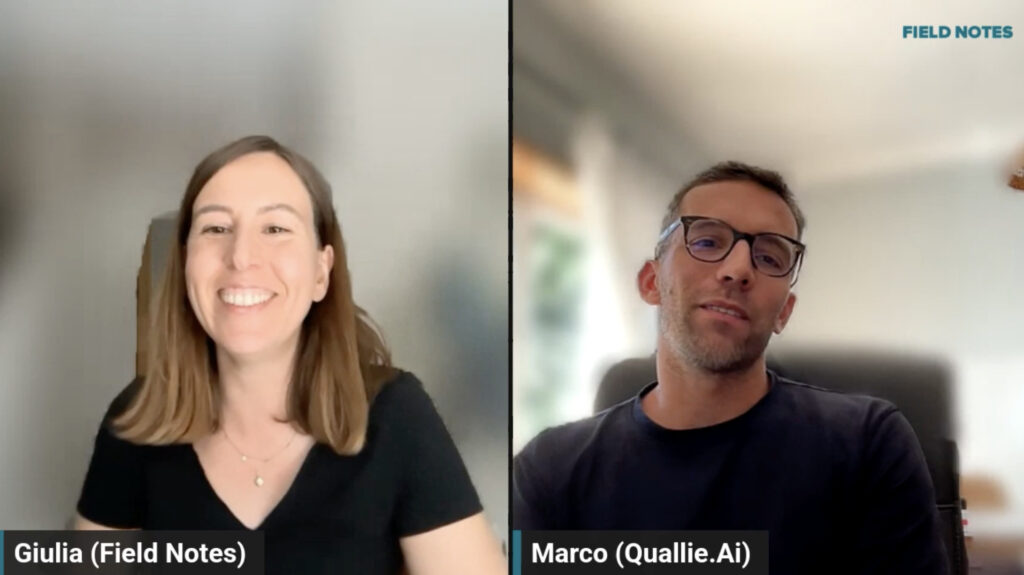
As part of our Q4 Ready webinar series, we sat down with Marco Rovagnati, co-founder of Quallie.Ai, for a deep-dive session on a topic that could not be more vital for modern researchers: What does “Good Work” actually look like in the age of AI?
With AI tools advancing rapidly, the industry narrative has often swung between extremes: doom and gloom about job replacement on one side, and over-enthusiastic tech evangelism on the other. Rather than getting caught up in the hype or the anxiety, Marco’s team went straight to practitioner researchers to explore how top qualitative talent is maintaining craft, integrity, and human depth alongside technology.
Here are the key takeaways from our conversation on how to define, deliver, and elevate good work in qualitative research.
Moving Beyond the Hype: Critical Thinking over Commoditised Code
One of the most striking points Marco highlighted is that the ability to build and process things quickly has become commoditised. A small team of AI-assisted engineers can build software in days, and an LLM can process thousands of words in seconds.
Because speed and execution are so accessible, the real commercial value has shifted back to human judgment and critical thinking.
Knowing what questions to ask, why a business needs an answer, and how to interpret subtle human nuances is where qualitative researchers bring unmatched value. Technology can do the heavy legwork, but researchers remain the ultimate guardians of meaning.
The Three Pillars of Good Work: Actionable, Viral, and Crystallised
During our discussion, three core characteristics emerged that define truly successful research in today’s environment:
1. Actionable: Designing for Impact from Day One
Good work is never just about explaining methodology or detailing what was done; it is relentlessly focused on impact.
- Informing Strategic Decision-Making and Growth: Marco defines good work as fundamentally actionable when it empowers stakeholders to make better, strategically relevant decisions that ultimately lead to growth
- Driving Organizational Change from the Start: He frames actionability not just as an end-of-project deliverable, but as an ongoing mindset that must guide proposal writing, methodological choices, and project execution – always keeping top of mind how findings will actually be applied to drive tangible change within an organization
2. Viral: Insights That Travel Organically Across the Business
The ultimate proof of good research is when insights move beyond the research department and spread spontaneously through an organisation.
- Making Everyone Excited: Marco describes “viral work” as research deliverables and outputs that are so compelling, high quality, and tangible that they naturally spread across an organisation on their own merits. Rather than staying confined to a single team or requiring continuous top-down advocacy, viral work resonates deeply with stakeholders, making people genuinely excited to talk about it and share it internally across different departments.
- Bringing Human Insights to Life: At the core of this virality is the ability to bring human insights to life in a vivid, relatable way that drives sustained, organic engagement. In Marco’s view, work truly achieves viral status when colleagues spontaneously revisit, reference, and build upon the findings long after the initial presentation, without any ongoing push or reminder needed from the research team.
This really resonates with us all at Field Notes, as research shows that visualising data makes insights up to 60% more memorable compared to text-dense reports. Incorporating short, authentic video and audio snippets dramatically increases message retention among busy stakeholders and supports the virality of the insights.
3. Crystallised: Sharp, High-Retention Deliverables
Sometimes pausing to think feels like a waste of time, especially when deadlines are tight and AI makes it so easy to get key answers straightaway.
However, crystallisation can’t be rushed. It’s the deep, craft-oriented dimension of research that mirrors human cognition:
- Embracing Confusion and Deep Immersion as Part of the Craft: Crystallisation is an inherently slow, cognitive journey that requires researchers to fully immerse themselves in the material and sit with ambiguity. Feeling disoriented is not a failure of analysis, but a necessary, productive phase in working through complex qualitative data.
- Taking Time to Arrive at Meaningful, Communicable Insights: The process of formulating and communicating an insight requires allowing sufficient time for disparate observations to resolve into sharp, articulated meaning. For Marco, honoring this process is essential to staying true to the craft of research and rigorous critical thinking, ensuring that final insights are genuinely earned rather than superficially assembled.
Avoiding the “Helicopter Trap”
A brilliant metaphor shared during the webinar was the danger of the “helicopter trap” in AI analysis.
If you upload raw transcripts into a generic AI prompt and ask for insights, the AI can drop you at the top of the mountain by helicopter. You arrive at a conclusion, but you have no idea how you got there. You cannot describe the pine forest, the rocky path, or the subtle turns along the way.
When you walk the trail as a human researcher, you understand the delicate context, the emotional hesitations, and the cultural nuances. AI is a fantastic assistant for mapping the terrain or sorting data, but human immersion is what gives you the confidence to stand behind your strategic recommendations.
Summary: A Healthier Relationship with AI
The consensus from our session is clear: the industry dust is settling into a much healthier, pragmatic relationship with AI. AI moderation, automated transcriptions, and rapid synthesis tools are finding their rightful place alongside in-depth qualitative methods, mobile self-ethnography, and quantitative research.
By staying curious, keeping technology contained as a support tool, and focusing on actionable, viral, and crystallised outcomes, qualitative researchers can ensure their craft remains indispensable.
A huge thank you to Marco Rovagnati for joining us and sharing his insights!
Get in touch to find out more about how Field Notes leverages AI to deliver good work! hello@fieldnotes.space