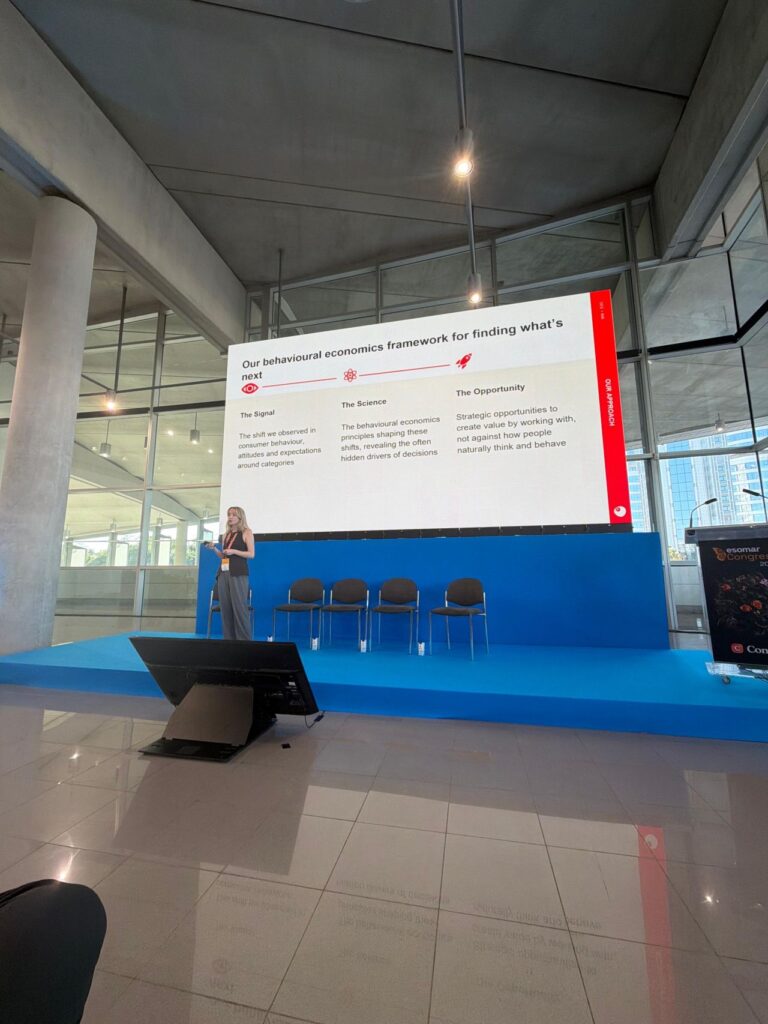
There was a very special moment for all of us at the ESOMAR Global Congress in Valencia recently as Emily Walsh from See Research took home Silver in the Young ESOMAR Society Award, for her study “The Behavioural Backlash against the Cult of Wellness”.
It was a fantastic achievement for Emily and the entire See Research team. It also proved that when independent agencies innovate with smart, collaborative methodologies, they can stand shoulder-to-shoulder with the largest players in global research.
At Field Notes, we were thrilled to collaborate on this project alongside Quilt AI and Tellet. Beyond the award itself, what makes this study a landmark piece of work is its research design: a textbook example of how to combine traditional research methods and AI tools in a complementary workflow rather than treating them as competing methodologies.
Ending the “Methodology War”: AI vs. Human Depth
In recent years, our industry has often framed research tech as a stark choice: you either choose human-led, deep qualitative approaches or you choose automated, high-speed AI interviews.
This project proves that putting these methods in contrapposition is a mistake. AI platforms and traditional qual do not need to compete; they work best when built on each other’s unique strengths.
When See Research set out to explore how consumers navigate health and wellness across diverse sectors (including FMCG, technology, health, and sports), they deliberately designed a four-stage, hybrid workflow. Each tool was brought in at the exact moment it could deliver the most value.
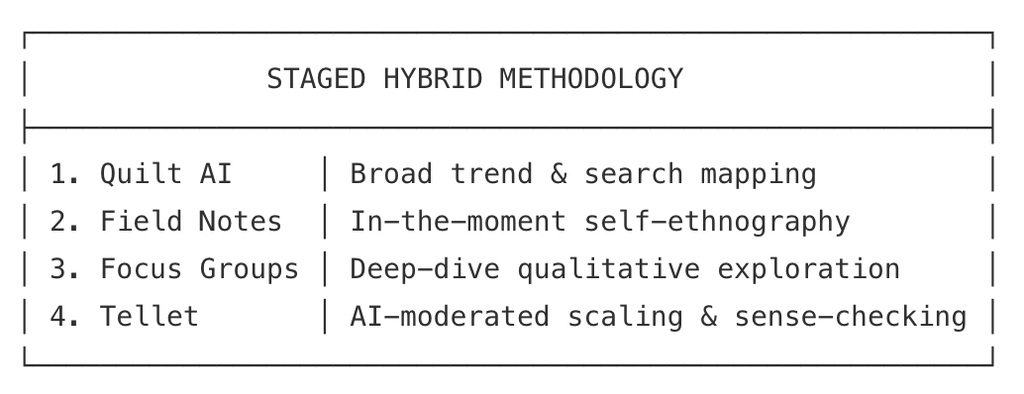
The Staged Research Workflow: How the Tools Built on Each Other
1. Quilt AI: Mapping Broad Cultural Trends and Search Data
The project began by leveraging Quilt AI to analyse macro-level social media data and Google search patterns. This initial stage mapped overarching consumer conversations, establishing baseline hypotheses and identifying key signals across the wellness landscape before talking directly to participants.
2. Field Notes: Uncovering Unstated Behaviours and Hidden Realities
To understand what consumers actually do in their daily lives versus what they say they do, See Research ran a week-long digital self-ethnography study on the Field Notes platform across Gen Z, Millennial, and Gen X cohorts.
Participants used mobile video diaries and screen-recording features to document their health routines and digital habits. This captured subtle, unscripted behaviours that standard focus groups and IDIs tend to miss.
For instance, one participant used screen recording to show how they consumed health content online. In doing so, they inadvertently revealed that they had set their smartphone screen to greyscale as a personal coping mechanism to limit dopamine hits – a fascinating behavioural adaptation that the participant had never thought to mention during traditional group discussions.
3. Focus Groups: Qualitative Context and Group Dynamics
Traditional focus groups were brought in as a core qualitative anchor to explore reported statements, discuss cultural perceptions, and probe into the emotional drivers behind consumer habits.
4. Tellet: AI Conversational Interviews for Scale and Sense-Checking
Rather than using AI moderation at the very start, See Research intentionally placed Tellet’s conversational AI at the final stage of the workflow.
By this point, the team had rich ethnographic video data from Field Notes and core qualitative themes from the focus groups. They used Tellet’s AI-moderated video and voice-note interviews as a rapid sense-check to fill specific data gaps, test their emerging hypotheses at scale, and gather concise, visually engaging voice snippets for the final presentation.
The Finding: “The Behavioural Backlash against the Cult of Wellness”
By synthesising data across these complementary channels, See Research uncovered a profound consumer shift.
Applying a behavioural economics lens, the study revealed that consumers are feeling increasingly overwhelmed by the relentless demands and contradictory rules of modern wellness culture. In response, they are quietly rebelling. Rather than following complex regimes, people are relying on simple heuristics and mental shortcuts, such as assuming that products with fewer ingredients are automatically healthier.
Without the combination of broad trend data (Quilt AI), unvarnished behavioural evidence (Field Notes), qualitative depth (focus groups), and hypothesis verification at scale (Tellet), this nuanced narrative would have remained hidden.
Key Takeaway for Research Teams
The lesson from Valencia is clear: the future of research excellence is not about replacing human ethnography with AI, nor is it about ignoring innovation in favour of traditional methods.
It is about thoughtful staging. Use AI to do the broad legwork and hypothesis verification, and use mobile self-ethnography to capture the messy, authentic human context that algorithms cannot predict.
A massive congratulations once again to Emily Walsh, See Research, and our fellow methodology partners Quilt AI and Tellet!
If you would like to explore how to combine Field Notes with your existing qualitative or AI analysis tools for an upcoming proposal, feel free to get in touch or book a quick 30-minute team refresher with our team | hello@fieldnotes.space