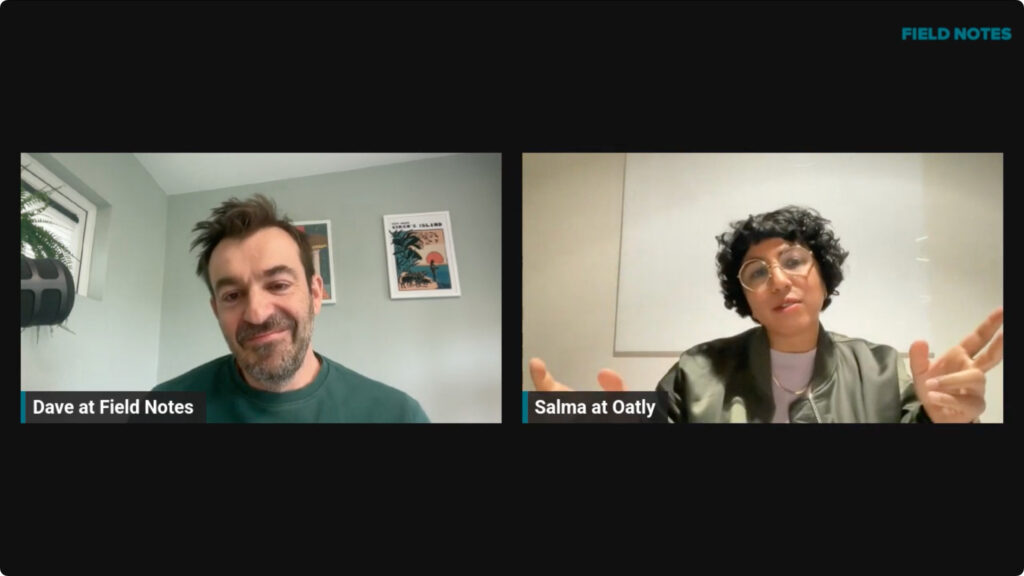
Last month, we had the pleasure of hosting Salma Gaj Topham from Oatly for a discussion on “How to Tell Compelling Stories.” At Field Notes, we believe that “remote doesn’t have to be distant”, and Salma’s approach to narrative perfectly aligns with our mission to bring participants’, patients’ and employees’ voices into the room.
With a background ranging from reality TV production to research and insight, Salma knows exactly how to bridge the gap between dry data and entertainment.
Here are her top tips for turning research findings and participant generated content into narratives that stick.
1. Remove All Fluff
In a world of short attention spans, brevity is king. Salma’s first piece of advice was blunt: “Remove all fluff“.
Whether you are delivering an idea internally or creating social media content, everything should be condensable into one or two sentences. As Salma noted, even complex sustainability goals at Oatly are distilled into a digestible format. If you can’t make it succinct, you haven’t refined the story enough.
2. The 3-Second Rule: Be Direct
“It’s actually difficult for a lot of British people to be direct“, Salma joked, but in storytelling, it is essential.
You need to land your idea in the first three seconds. You don’t need your audience to understand the entire intellectual argument immediately, but you do need to hook them emotionally. A powerful image or a bold statement at the very start can communicate a sentiment instantly, drawing the audience into the rest of the presentation.
3. Embrace the “Awkward” (and the Humorous)
One of the most surprising takeaways was the value of awkwardness. Salma shared her “fly on the wall” documentary approach: sometimes you have to make things awkward to extract a moment of truth.
- The “Anti-Praise” Technique: When filming vox pops for Oatly, Salma asks participants: “I don’t want you to say anything nice about Oatly… If it’s bad for our brand, that’s okay”. This tension creates authentic, hilarious, and deeply human reactions that are far more engaging than standard praise.
- The Deprivation Task: We discussed how this applies to mobile ethnography and video diaries. One of the best ways to get powerful content is the “Deprivation Task” – for example, asking coffee lovers to go without coffee for a week. The resulting videos are often funny, raw, and incredibly revealing about the product’s role in their lives.
4. Cast “Personas,” Not Just Demographics
When recruiting for a study, it is easy to focus on demographic buckets. Salma suggests, when possible, borrowing a trick from reality TV: Casting.
She creates imaginary personas based on characters from fiction or Netflix series to visualize the “types” of energy she wants in the mix. This ensures you don’t just get a representative sample, but a group of dynamic, charismatic individuals who can actually tell a story and bring opposite and sometimes extreme points of view to the table.
5. Capture the “Nugget of Relatability”
Finally, we discussed a trend we are seeing more of at Field Notes: using the final task of a project to capture “B-Roll” or a “clean capture” of a powerful insight.
Don’t just end the project when you have the data. Go back to the participant and ask them to re-tell a specific story or share a final thought. As Salma explained, getting that “last glue or nugget of relatability” is often the thing that connects a room full of stakeholders.
Summary
Storytelling isn’t about inventing a fairy tale; it’s about revealing the human truth hidden in your content – sometimes by doing things a bit differently.
A huge thank you to Salma Gaj Topham for joining us. If you wish to watch the full webinar recording, you can find it here.