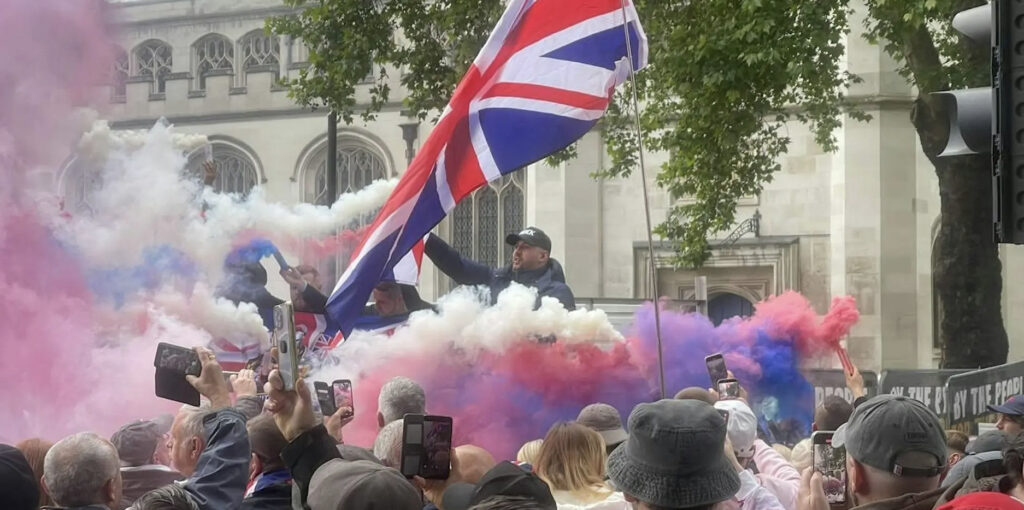
On May 16, tens of thousands of people marched in London for the Unite the Kingdom rally. While the mainstream media focused firmly on the main stage and the event itself, Resilience and Reconstruction wanted to see what it looked and felt like from the inside, as well as to deeply understand the people taking part.
Who was attending? What motivated them to join? What do they believe in? What are their lives really like? At a time of such significant political and cultural change, these questions matter more than ever.
That’s why Resilience and Reconstruction decided to run a self-funded, comprehensive piece of research with the goal of pure understanding: approaching the attendees with curiosity rather than assumption, and understanding the country we live in without judgment.
The project consisted of accompanied visits, follow-up groups, and control groups. Field Notes and our sister agency Peek provided the technology and managed the self-ethnography component.
A Journey into Authentic Lives
To truly understand the motivations of the attendees, the self-ethnography component of the research focused on capturing immediate, raw, and authentic moments and opinions. Over five days, the participants completed a series of mobile tasks on Field Notes, designed to uncover their unfiltered realities.
For example, participants were asked to provide a “Quick Tour” of their homes to show us their day-to-day world, and to complete “Feed Tours” using screen recording to show us exactly who they follow and trust on platforms like X, YouTube, and TikTok. We also asked for raw “Morning After” videos to capture how they felt physically and emotionally immediately following the event. Finally, they conducted a “Media Sweep” to compare how the rally was being reported in the news versus what they actually saw and experienced on the ground.
Going Beyond the “Angry White Man” Stereotype
When discussing movements like this, it is incredibly easy for society to default to a specific prototype: the “angry white man” who is suspicious, deeply distrustful of mainstream media, and feels looked down upon by the middle class.
However, self-ethnography allowed to challenge those assumptions, uncovering that the march was much wider and far more nuanced than the stereotype suggests. The research captured a highly diverse crowd that included young, university-educated debaters, older generations, and a mix of ethnic minorities.
What united these attendees was not simply anger, but a profound lack of trust in the establishment and a deep sense of solitude. The research revealed that they are often driven by a protective “fear for” their communities, rather than just a “fear of” outsiders. Underneath the frustration is a genuine desire for dignity, influence over their future, and a need to be heard. For many of the participants, the rally was not experienced as an expression of hate, but as a rare space for community, love, and belonging.
The Power of Platform-Led Storytelling
By meeting participants on their own terms and where they are, we were able to go beyond the political labels and uncover the deeply human stories driving their choices.
Reflecting on the project, Steven Lacey, Co-founder of Resilience and Reconstruction, highlighted the impact of this approach:
“The Field Notes platform was incredibly powerful in bringing authentic voices to life. By capturing the attendees’ intimate stories and immediate, raw moments directly from the inside, we were able to go beyond the stereotypes and truly understand the nuances and complex drivers that standard reporting completely misses.”
If you are interested in learning more about how self-ethnography can help you decode complex social issues, get in touch with us today!