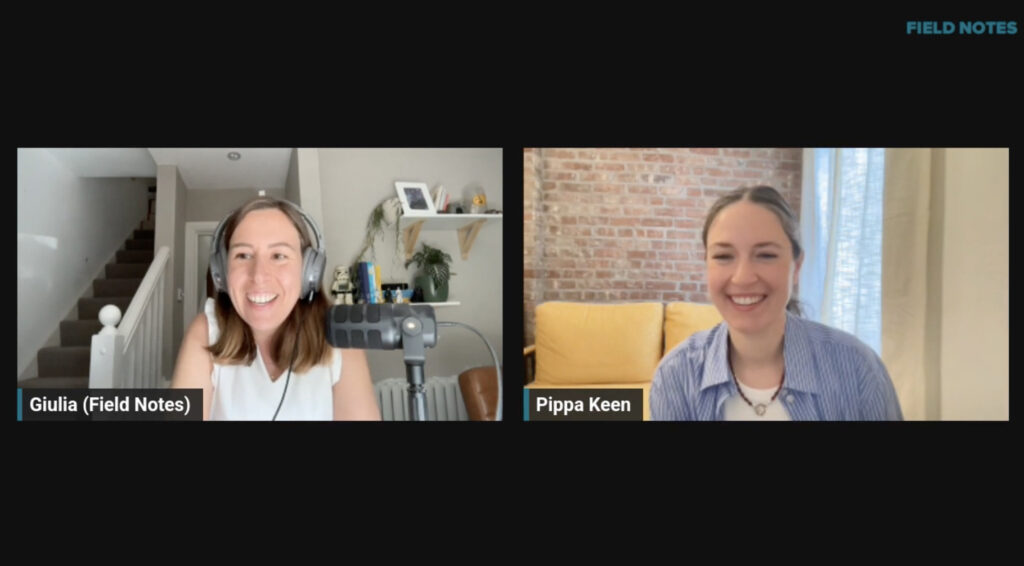
As part of our Q4 Ready webinar series, we had the pleasure of chatting with Pippa Keen, Senior Staff Researcher at Etsy, to explore what life is really like on the client side.
Having spent five years working agency-side before moving to New York to join Etsy nearly eight years ago, Pippa has a unique, dual perspective on both sides of the insight world.
In her current role at Etsy, Pippa’s projects span foundational work like market entry, audience expansion, and fast-turnaround creative and prototype testing. She works across both qualitative and quantitative methods, partners closely with C-suite stakeholders, and has led insight work behind major strategic shifts, including Etsy’s pivot towards Gifting.
Here is a recap of Pippa’s key insights on navigating stakeholder demands, the impact of AI on project speed, when in-house teams turn to agencies, and how to deliver outputs that truly travel across an organisation.
1. Agency vs Client-Side Dynamics: Pulling in the Same Direction
Reflecting on her transition from agency life to client side, Pippa noted that agency experience provided an invaluable grounding in context-switching, rapid problem-solving, and relationship building. However, the core difference lies in internal alignment.
Agency researchers often feel the constant pressure of pitching for new business or proving their worth to clients. On the client side, while rigorous internal debates still happen, everyone is explicitly pulling in the same direction toward unified company goals – such as business growth, seller success, and buyer satisfaction.
This really resonated with us: when agencies pay their part to truly embrace that shared destination, the whole relationship transforms. It moves you away from a transactional ‘vendor’ mindset and turns you into a trusted thought partner who is walking alongside the client toward the same finish line.
2. The Reality of AI and the Demand for Velocity
When asked about her single biggest day-to-day challenge, Pippa’s answer was immediate: speed.
Stakeholders and internal tech partners are now operating at an unprecedented velocity, largely driven by AI tools that make it effortless to generate prototypes and put ideas in front of users instantly.
“AI has changed the way that our partners work… They are working now at a velocity, they are being asked to work at a velocity. How do we keep pace with that and find and build the trust from the organisation to know when are the moments that we need to say, let’s slow down and take a breath here?”
The key for researchers is learning to enable this momentum without becoming a bottleneck or a thorn in the team’s side. It also requires accepting that few business decisions are permanent “one-way doors” – most initiatives can be tested, adapted, or pivoted as new evidence emerges.
It sounds like one of the huge advantages of AI is that rapid prototyping and hypothesis testing can happen quickly and with limited upfront investment. However, this same velocity can easily encourage teams to rush in and execute without taking a breath to pause, reflect, and evaluate the bigger strategic picture.
3. When In-House Teams Turn to Agencies
Tech companies like Etsy run a substantial proportion of their research in-house due to a strong UX heritage and direct access to their own user bases. However, in-house teams turn to external agencies when they need specialised methodological skill sets (such as semiotics or behavioural science), access to niche non-user audiences, or local international market nuances.
Conversely, the biggest barriers to commissioning agencies are not around costs but around speed and added management overhead. Long proposal turnarounds miss tight project windows, and client-side leads worry that managing an agency might create additional review work rather than saving time.
This is where agencies can truly differentiate themselves by focusing on making the commissioning client’s life easier at every single stage – a core theme that also echoed strongly in Paul Griffiths’ webinar on winning proposals:
- Upfront Clarity: Replacing 70-slide proposal decks with a crisp, single-page executive summary outlining the problem, approach, timeline, and investment.
- Constant Communication (No “Grand Reveal”): As Pippa emphasised, clients don’t want a “grand reveal” at the very end. Regular, lightweight touchpoints keep the client aligned so there are no awkward surprises:
“Communicating throughout the project… having some really concrete checkpoints where I can help shape things… so you’re not going away and having a grand reveal to me… You know what’s coming, I know what’s coming.” - Preventing Internal Friction: Checking in regularly allows the client to flag internal terminology or “landmine” words that could trigger unnecessary pushback from internal stakeholders before a deck is finalised.
4. What End Clients Need: “Summarise or Be Summarised”
To maximise impact across different internal audiences, Pippa highlighted two distinct approaches – offering a brilliant lesson for agencies not to be afraid to ask their commissioning client upfront who their internal stakeholders are, how they digest information, and how they prefer to work:
- For Executing Teams: Involve stakeholders directly in the research journey through “safaris”, observation, co-moderating, or on-the-fly debriefs to build organic buy-in.
- For Executive & C-Suite Stakeholders: Operating under the reality of a phrase Pippa noted from her workplace: “summarise or be summarised”.
“A phrase that has been used that I don’t love, but is the reality of the world we’re working in now, is ‘summarise or be summarised’… So actually thinking, for our more executive audience, how can I be as crisp with them about what this means for them? And that might be two sentences… And those two sentences show up all over the business because they’re using those two sentences in a press release or when they’re talking to teams.”
Choosing those two sentences intentionally is the ultimate test of strategic synthesis.
The Power of Short Video Snippets:
Alongside crisp written summaries, Pippa pointed out that senior leaders respond immensely well to short, 30-second “talking head” video clips. Seeing a real customer encounter a friction point creates an instant emotional connection that slides of bullet points simply cannot match.
This resonates deeply with our core philosophy at Field Notes: video is one of the most powerful mediums for communicating human truth and creating memorable insights that actually stick.
Ultimately, end clients are looking for “outputs that travel” – succinct, easily shareable assets that can be distributed across an organisation to drive real strategic action.
Summary
Successful agency-client relationships are built on two-way trust, proactive communication when fieldwork hits bumps, avoiding the grand reveal, and a deep appreciation of internal stakeholder dynamics. By asking the right questions upfront, cutting unnecessary fluff, and delivering bite-sized assets that travel easily, agencies can make themselves genuinely indispensable to client-side teams.
A huge thank you to Pippa for sharing her time and candid reflections with us!
Get in touch to discover how mobile self-ethnography and short video deliverables can help your team capture authentic customer stories and create pitch-winning proposals this Q4.