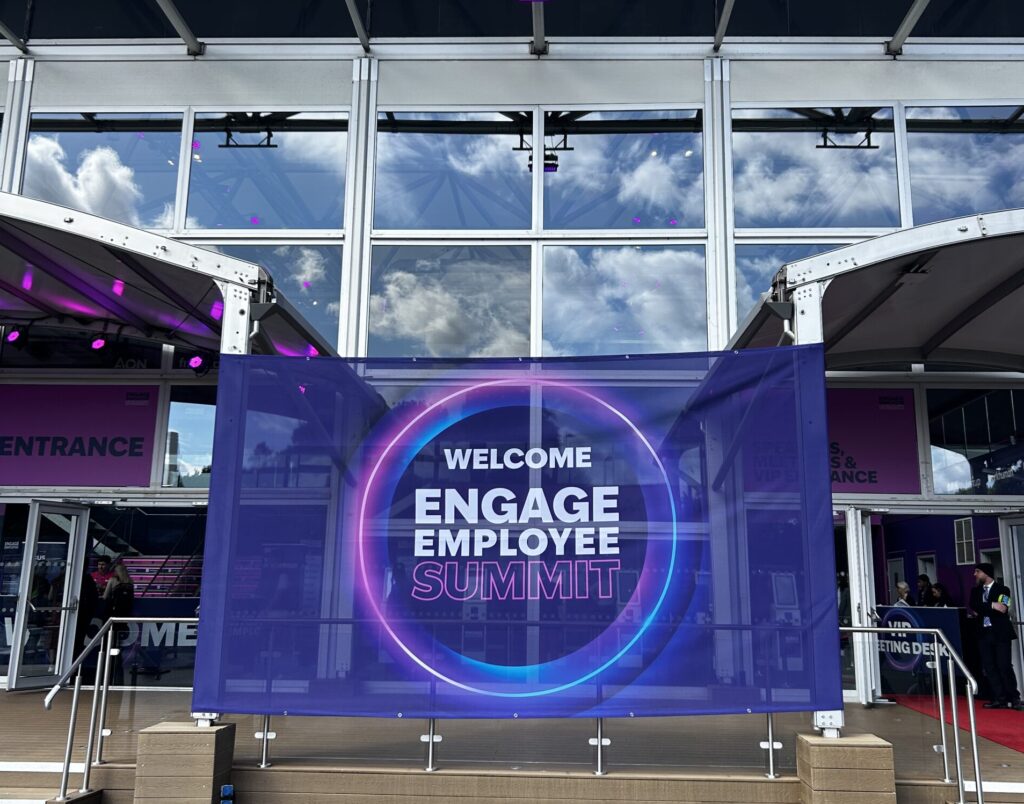
Earlier this week, I attended the Engage Employee Summit in London, joining hundreds of HR, culture, and internal communications leaders to discuss the real challenges facing modern workplaces.
As the working landscape continues to change at a rapid pace – particularly with the ongoing integration of AI and new technologies – gathering authentic employee feedback is more important than ever. Throughout the event, several powerful themes emerged around how we capture, understand, and act upon employee voices.
Here is my write up of my three key takeaways from the summit, and why the evolving conversation around workplace culture feels so aligned with our philosophy at Field Notes.
1. Uncovering the “Why” Through Active Listening
A central theme of the event was the recognition that one-off, static surveys are simply no longer enough. While they provide a high-level snapshot of a situation, they are inherently passive and consistently fail to bring to life the real “whys” behind the data.
Feedback must be gathered in context, not in a vacuum. As Caroline Abercrombie brilliantly noted, it is crucial to dig into the why behind the data. She highlighted that getting feedback upfront allows you to build frameworks around it, saving you from having to reverse engineer solutions later, reminding the audience: “What we feel as SLT is an issue doesn’t mean that it also matches what employees think it’s the issue”.
Emma Woodford, Chief People Officer at LV=, echoed this sentiment, arguing that we must break down the assumptions that come with standard surveys, and instead use intimacy and connection as a way to build genuine engagement.
To put people first, organisations must shift towards two-way conversations. Nick Court, CEO of The People Experience Hub, summed this up perfectly: “Surveys by default are a push event, they don’t support active listening”. He stressed that “listening is not an event, listening is always on”.
This specific point strongly resonates with our core philosophy at Field Notes. We have always championed an always-on approach to employee engagement. By empowering organisations to capture the authentic, lived experiences of their teams in real-time, we believe businesses can secure the vital context needed to truly understand the human stories behind the statistics.
2. Closing the Loop and Cutting Through the Noise
Gathering the feedback is only half the battle. Once you have the insights, you must efficiently close the feedback loop so employees know their voices have been heard. As Janina Norton, Global Head of Culture at AXA, advised, it is vital to “close the loop with relevant communications and show people how their feedback truly created change”.
To do this successfully, internal communications must cut through the noise, which requires a deep understanding of where and how these communications are actually received and experienced on the ground.
A fantastic example of this came from Vicky Hicks, Head of Internal Comms at Openreach. With 90% of their 24,000-strong workforce out in the field, she actually spent a day in the field to see firsthand how frontline workers interact with corporate messaging. I loved this anecdote as it really reminded me of my qualitative researcher days, and the importance of getting closer to your audience.
Similarly, Sarah Fox, Corporate Communications Lead at Evri, shared how she visits depots to understand the physical environment her team operates in – spaces where phones are often not allowed – proving that communication strategies must adapt to the lived reality of the employees.
This reflects exactly why we must put ourselves in their shoes and assess in context whether communications might land. Sometimes it is not just about fine-tuning the message, but truly understanding who is at the other end of the line and how the message is received.
3. The Shift to Total Experience (TX)
Finally, it’s exciting to see how the conversation is shifting from isolated Employee Experience (EX) or Customer Experience (CX) towards Total Experience (TX).
Total experience (TX) is an integrated business strategy that combines customer experience (CX), employee experience (EX), user experience (UX), and multi-experience (MX) to optimise overall business outcomes.
Lukasz Peliksza, Chief Employee Experience Officer at Erste Bank Poland, presented a compelling case study on how they have merged EX and CX into a single, unique system. He challenged the idea that emotions are just “soft” metrics, explaining that “they are deeply operational – they shape trust, behaviour and decisions”. By giving equal attention to employees and customers, the logic is simple but powerful: happy employees lead to happy customers. As Lukasz highlighted, “Understanding the why as the starting point of the total experience is what ultimately allows you to define the what and inform the how.
Given our deep roots in consumer research and our growing footprint in the EX space, this shift towards TX feels like an incredibly exciting opportunity for us at Field Notes. Bridging the gap between consumer and employee insights is exactly what our technology was built to do, allowing businesses to map and understand human experiences across the board.
Summary
The Engage Employee Summit made one thing abundantly clear: the days of passive listening are over. To build high-performing, resilient cultures, organisations must embrace active, always-on conversations, ensure their communications are grounded in the everyday reality of their teams, and recognise that employee emotions are a fundamental driver of business success.
If you are ready to dig into the “why” behind your data and start capturing the authentic lived experiences of your team, I would love to chat. Our mobile-based video diaries and in-app messaging tools allow you to establish genuine two-way conversations that bring your employee voices to life. Book a Demo today to see how we can help.